What Is the RAADS-R Test?
The RAADS-R, short for the Ritvo Autism Asperger Diagnostic Scale-Revised, is a self-report questionnaire designed to help identify autistic traits in adults. It was published in 2011 by Dr. Riva Ariella Ritvo and colleagues as a revision of an earlier scale, and it was built with one group in mind: adults who may have gone through life without ever being assessed. Many autistic adults, particularly women, late-diagnosed people, and those who learned to mask their traits, were overlooked in childhood because the criteria and clinical pictures of autism were narrower then.
The test contains 80 statements. For each one, you indicate whether it is true now and whether it was true when you were young, using answer options such as "true now and when I was young," "true only now," "true only when I was young," and "never true." That two-timeline format matters because autism is a neurodevelopmental condition, meaning its traits are expected to be present early in life even when they look different in adulthood.
What Does the RAADS-R Measure?
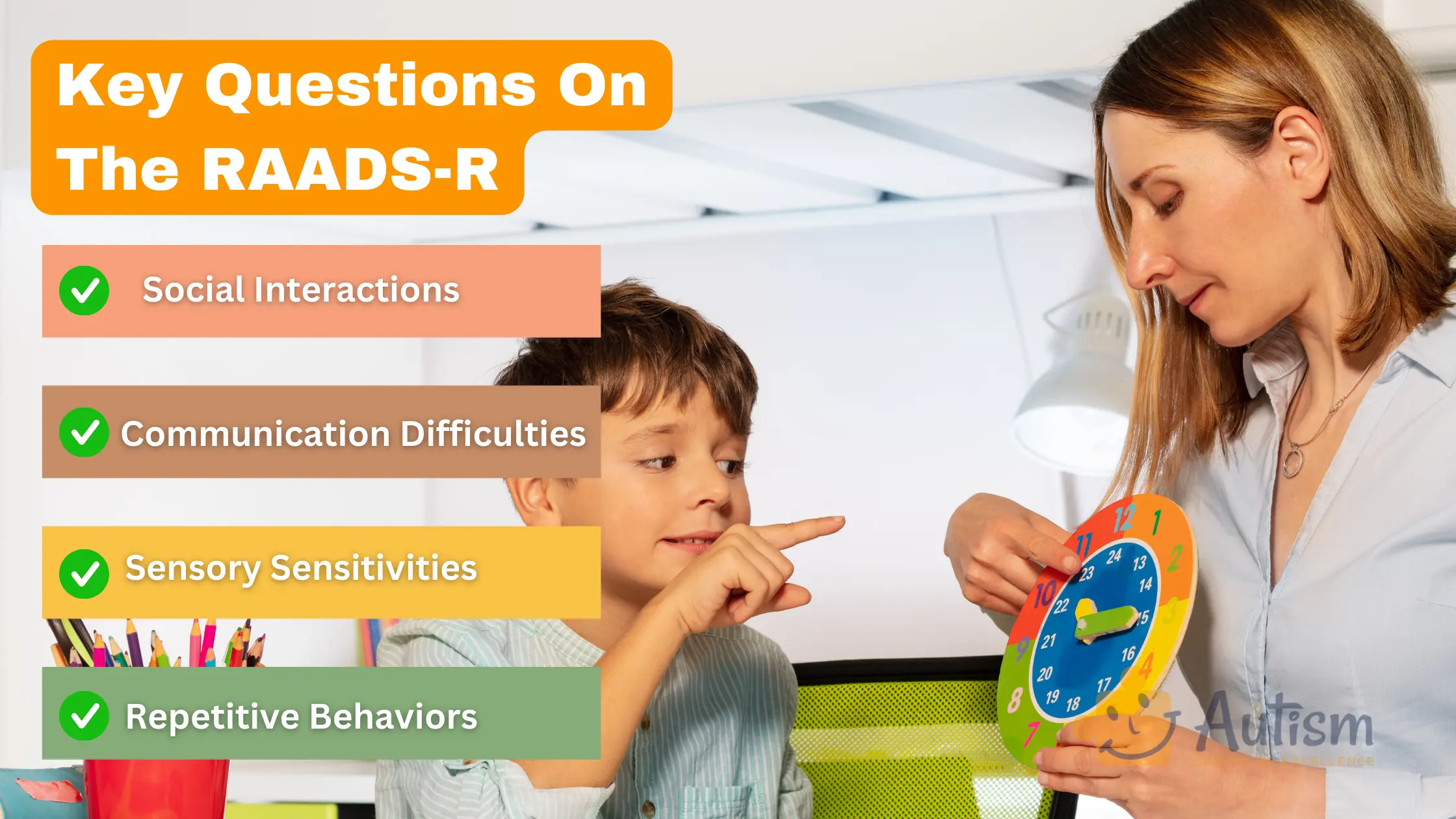
Rather than producing a single vague impression, the RAADS-R groups its statements into four areas that reflect core features of autism. Your answers in each area contribute to a total score, and the pattern across areas can be just as informative as the total.
In the original validation research, a total score of 65 or higher was found to be a reasonable threshold for separating adults with autism from comparison groups, and the scale showed strong sensitivity in that study. Higher scores simply indicate that you have endorsed more autistic traits. Like any questionnaire, the result depends on how honestly and accurately you describe your experiences, which is why many people find it helpful to answer while thinking about their childhood and adult life as a whole, not just a recent bad week.
A Screening Tool, Not a Diagnosis
Important: The RAADS-R cannot diagnose autism. It is a screening and self-reflection tool. Only a qualified clinician, such as a psychologist, psychiatrist, or neuropsychologist with autism expertise, can provide a formal diagnosis after a full evaluation.
A high score does not automatically mean you are autistic, and a low score does not rule it out. Other conditions, including ADHD, anxiety, trauma-related conditions, and social anxiety, can overlap with some of the same traits and sometimes influence results. What the RAADS-R does well is give you structured language for your experiences and a concrete document to bring to a professional if you decide to pursue an evaluation.
Why Adults Take the RAADS-R
People come to this test for many reasons. Some have spent years feeling "different" without being able to say why. Some have a child or relative who was recently diagnosed and recognize themselves in the description. Others have been told they have ADHD, anxiety, or depression, yet feel those labels do not explain everything. Getting a clearer picture of your traits can support self-understanding, better workplace or school accommodations, and more targeted conversations with healthcare providers.
Other Tests Used for Autism
The RAADS-R is only one tool in a larger landscape. Some other assessments you may come across include:
- Autism Spectrum Quotient (AQ): A 50-item self-report questionnaire developed by Simon Baron-Cohen and colleagues, widely used as a quick screener for autistic traits in adults.
- Camouflaging Autistic Traits Questionnaire (CAT-Q): Measures how much a person masks or compensates for autistic traits in social situations, which is especially relevant for late-identified adults.
- Empathy Quotient (EQ) and Systemizing Quotient (SQ): Research questionnaires that explore different cognitive styles often discussed in relation to autism.
- Social Responsiveness Scale, Second Edition (SRS-2): Rating scales that capture social communication and repetitive behavior, completed by the individual or by someone who knows them well.
- ADOS-2 (Autism Diagnostic Observation Schedule): A clinician-administered, structured observation of communication, social interaction, and play or imagination, often considered a gold-standard component of formal evaluation.
- ADI-R (Autism Diagnostic Interview-Revised): A detailed clinical interview, usually with a parent or caregiver, about developmental history.
Self-report screeners such as the RAADS-R and AQ are quick, private starting points, and you can try the RAADS-R for free at Raadsrtests.com if you want somewhere simple to begin. Observation tools such as the ADOS-2 and interviews such as the ADI-R are used by trained professionals as part of a comprehensive diagnostic process. Many people find it valuable to take more than one screener and compare their results, remembering that no single number defines you.
Take the RAADS-R Test Free on Raadsrtests.com
If you are curious about your own results, the RAADS-R autism test is completely free to take online at https://raadsrtests.com/. There is no cost to start it, and you do not need to pay to see your result. You can work through the statements at your own pace, in a quiet place, and without anyone looking over your shoulder. The same website also offers a free neurodivergence test for people exploring a wider range of neurotypes, and a free AudHD test for those who suspect both autism and ADHD may be part of their story.
Tips for answering as accurately as possible
- Answer for who you are most of the time, not on your best or worst day.
- Think about your childhood as well as your adult life, since the test asks about both.
- If you tend to mask, try to answer based on what is natural for you, not what you have learned to perform.
- If possible, ask a trusted family member or friend for a second perspective on early memories.
- Save or screenshot your result so you can share it with a healthcare professional.
What to Do After You Get Your Results
Whatever your score, take a breath and treat it as information, not a verdict. A high score may be a good reason to seek a professional evaluation, ideally from a clinician experienced in diagnosing adults and in recognizing how autism can present in women, in people of color, and in those who mask. A lower score does not mean your struggles are not real; it may simply mean other explanations, or a different assessment, deserve a closer look. Online autistic communities, peer support groups, and reputable books and research summaries can also help you make sense of your experiences while you decide on next steps. And if you have not yet taken the questionnaire, you can take the RAADS-R online for free whenever you feel ready.
Ready to Find Out More About Yourself?
The RAADS-R is free, private, and takes only a short time to complete.